the beauty of queer love in 'Heated Rivalry' (and the limits of representation)
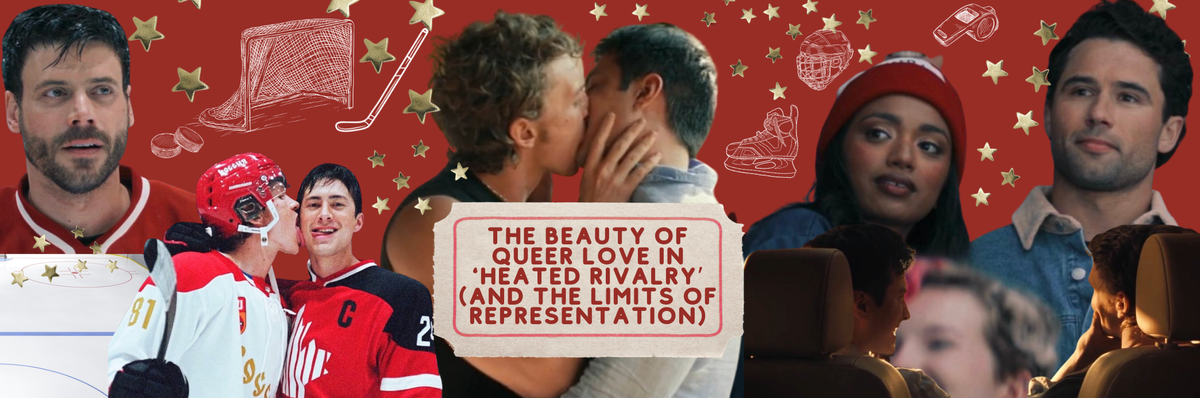
“CAN YOU BELIEVE THESE ABSOLUTE BOYFRIENDS WHO LOVE EACH OTHER SO MUCH AND ARE SO OBSESSED WITH EACH OTHER?” I texted my friend Jane (who lives in Canada and whose taxes pay for this newfound obsession) about Heated Rivalry last week. As if transported back to my high school self’s body, I am kicking my feet and giggling at the edge of my bed like 17-year-old me scrolling Tumblr to watch edits I'll reblog, only I’m on Twitter and Instagram and Ao3. And honestly every corner of the internet where I can find all things Hollanov (the ship name for the main characters of this first season, Shane Hollander and Ilya Rozanov).
I am gay. I am autistic. I am not immune to propaganda.
And not to spoil things so early on—but the truth is that all media is propaganda. Though as a gay autistic with a PhD in yearning from my days on lesbian Tumblr and One Direction Tumblr (iykyk) who grew up figure skating and watching hockey, this show has touched my heart deeply and thawed something I thought was frozen solid forever. I think it’s thawing many of our respective iceblock hearts, and could thaw something monumental collectively if we hold it up to the flame so we can see more clearly, and put words to what’s going on—name exactly what we desire.
In the last few weeks, I’ve heard so many people express shock and wonder around how the Canadian show speed-skated into our lives chaotically and brought lots of us together unexpectedly. Lots of people have said they don’t understand how a show about gay guys playing hockey could be captivating us so, piercing through the veil of the previously "boring" National Hockey League (NHL). Some have even jokingly dubbed it a “mass psychosis” event. But I’m not shocked by the collective tenderness and madness that I’ve watched unfold among all of us from different corners on the internet and out in the world.
As I’ve always said, there are queer people and there are people who just happen to be gay. I do not define queerness by who I am attracted to. I define queerness by how I love. Who I give love to and who I welcome it from. Sure, I fuck. But I could fuck a cis man if I wanted to (I don’t!) and still be as queer as I’ve always been, because other than rent, groceries and the MTA, all my money goes to queer friends and artists and people in general. It goes to Palestine. It goes to Lebanon. It goes to people who have been abducted by ICE. My time and energy and attention is spent on building the better world I want to live in, both in small ways and big—and medium, too.
Within the spectrum of queer media and stories, Heated Rivalry gives us something rare and nuanced. Not only does it absolutely fuck, giving us raunchy sex scenes that are deeply unashamed and unapologetic to be horny as hell, but it shows us community. It shows us chemistry and commitment. And it also works so well because the leads Connor Storrie and Hudson Williams are also best friends, according to them. They developed a closeness and built a foundation with each other that just clearly shines through the screen. It reminds me of some of my best friendships and both how tender and silly we are with each other, because of the vulnerability we express with one another.
In the universe of the show, we’re introduced to a stoic yet wholesome, autistic babygirl Asian hockey player who has horrific anxiety but wants to explore his queerness and accept himself despite his best efforts not to, with a loving, supportive family in Shane. And in Ilya, it gives us a Russian immigrant hockey player with a neglectful yet demanding biological family and complicated relationships with them, who has struggled to accept his queerness and his desires because of the culture he comes from. Heated Rivalry gives us Scott Hunter, an elder gay who’s kept himself in the closet for his whole life because the one thing he desires more than being with another man is winning the cup and making his dead parents proud, and he shudders to think that in coming out “too soon” that he might ruin the expensive, pristine life he’s built for himself. (OH, my beautiful, beautiful Not So Doomed Yaoi, I need you like water.) Finally, in its main character rotation, we have Kip Grady, an art student who works at a smoothie shop and becomes the apple of Scott’s eye over a quickly unfolding flirtationship that matches the intensity of lesbians U-Hauling (hey, gay men can do it, too!! Representation!)
No matter where you live, 2025 has been fucking rough. We’ve needed something to help get us to the final buzzer of the countdown on the scoreboard, if you will. To believe we could make it through another year. Time is fake, but I know it’s an understatement when I say that we’re all feeling the wear and tear of The Horrors that have unfolded recently—from the continued horrific escalation of the genocide in Palestine, to the genocides in Congo and Sudan, the warmongering from the U.S. government, the ICE raids, and the broad and deeply ingrained fascism.
It is true that it's putting many of us through the ringer of fandom obsession unlike anything I’ve seen in recent years (and I’m a #1 fan of Interview with the Vampire from AMC, though that fandom is much smaller)—and I’ve spent hours wide awake in the middle of the night talking with friends and total strangers about why this collective flurry of feelings is happening. Perhaps this is propaganda we need and deserve, as long as we can properly place it within cultural context and understand what’s being sold to us.
As someone who comes from and was raised by people of the global majority, and a little more specifically people from a mix of SWANA diasporas, I know that I will never get to experience certain types of "coming out" to family that are reserved for, quite frankly, a certain type of White white person that I am not. So I didn't enter my Heated Rivalry watch with the intention of seeking representation. I don't have the desire to come out to family members from other parts of the world who won't understand or who would feel uncomfortable with who I am. I don't need to be validated by them. I belong within my community. All that said, I was pleasantly surprised and in holy awe of the universally relatable moments that I did, in the end, feel deeply moved by.
It took a while to get to the good part in the first episode, which felt slow-moving and a little too BAM-here’s-a-montage-so-you-understand-how-time-is-passing for me to fully enjoy it. But once I got to the end and there was real tension and real stakes for Shane and Ilya’s relationship, I was flung into the net as if hockey puck, and now I’m stuck here tongue to ice, trying to stop myself from buying secondhand copies of every book in the series because I’ve already blown through every piece of fanfic on the internet.
Every character is messy in their own way and that relatability is soothing. I think we’re all tired of seeing cookie cutter characters who aren’t real people and aren’t allowed to make mistakes. The characters make mistakes—many, in fact. And they skate their way back to each other and the love they share even through it. We see Ilya push Shane away initially, not knowing how to handle his feelings, and we see Shane try to date a woman he’s not even sure he can have real feelings for, just because he’s trying to navigate Ilya’s distance. Scott asks Kip to move into his apartment and build a life with him too fast, even while knowing full well that he has no plans to come out any time soon, and that Kip will have to hide, too, because of Scott’s career. The more blatant, jarring elements of homophobia present in hockey within the real world, like players calling each other "f**got" openly and attacking each other, are not there. In real life, if he were a real player, Scott might even participate in that because of his internalized homophobia and his desire to remain safe. Even still, it's refreshing and hopeful to see a character who hurts someone he loves eventually find his way and repair things by doing them the way he should've in the first place. It doesn't quite feel good to me that Scott only comes out once he's reached a career goal that people will laud him for, but I do think it's realistic, and matches the ways so many of us who are queer and trans hide until we've reached a certain level of social safety that we feel affords us some leeway to be more vulnerable. That is the world we live in.
Other supporting characters make mistakes, too, Shane’s parents push him into the spotlight and brand deals, and ignore many of the ways he struggles with anxiety. In the moment that he has with his mother at the end of episode six, when she apologizes for hurting him and making him feel like he couldn’t come out sooner, it’s the continued attention to detail that matters. She doesn’t say “if I made you feel,” and Shane doesn’t say “it’s okay.” He says, “I forgive you” fully acknowledging that harm was done, but we can repair. What a significant character development for both of them, couched in such a small, precious moment that might otherwise be missed. It’s less a moment of pride and more a moment of reckoning and moving towards a better version of self.
This story offers us beautiful, intentional attention to detail again and again: the way that Shane lives in a “cottage” that’s actually a glass house (the metaphor showing that Shane is not hiding who he truly is for anyone who really knows him is painful in a satisfying way), or what the ginger ale that Ilya gets him represents about the ways he soothes him, or how Shane buys groceries for Ilya and makes sure they have all the food they need when he’s not even fully aware how much the gesture means because Ilya is always taking care of everyone else.
I’m biting my fist as I type because these are the smallest, most beautiful forms of love I have in my own life. I feel the same groundswell of gratitude and amazement that I do in these moments on Heated Rivalry when, in my own life, I accompany a friend to a medical appointment so they feel a little less alone and have support, or bake at friends’ houses, or do their dishes, and when my closest people make me gifts just because, or text me to ask if I can read their new novel or poem because they trust my feedback and opinion, or come to clean the grime off my stove because I’m too tired, or show up at my apartment with coffee or hot cocoa when I need it. When I'm having a bad day and I am held, and have a couch to sleep on because I just don't want to be alone in my own apartment right then.
I am not even going to say just how many times I’ve rewatched episodes 5 and 6—particularly the scenes when Scott Hunter kisses Kip on the ice and comes out publicly in front of the whole world after winning the cup, and when Shane and Ilya stay at the cottage together. The limit does not exist. I haven’t felt this way watching a piece of queer media in years. There’s only a handful of times I can count that I have sobbed the way I wailed like I am 15 again, while curled into a ball on my couch in the apartment that I pay for with my adult money paid for by adult jobs—my inner teen jumping out and taking the wheel. I cried even harder when Ilya and Shane got to be together at the cottage without worrying about the masks they wear in the outside world, trying to appear one specific way to protect their careers and reputations in a homophobic sports world.
When Shane tries to close the curtains and turn the lights off and Ilya moves his hand away, wanting to fuck him in the sunshine with the windows uncovered, I screamed. Queer people deserve sunshine. Let them see us fuck! Let them see us love. Let them see what it means to be fully human.
@bomanizer I’m gonna be okay
♬ original sound - bella ☮︎
The last few pieces that I can compare Heated Rivalry to, that felt this tender and authentic, would be the movie Love, Simon, and of course Call Me By Your Name (and I have my own longform critiques of both that now is not the place to Get Into It fully because they’re also both serving slightly different purposes than this gay boy hockey show). Yet both of these fell short in ways that Heated Rivalry strikes me as really meaning to go for gold, at least in terms of the breadth and depth that queer stories can show us. Love, Simon is about a kid from a rich family in suburbia who happens to be gay and has an otherwise perfect life full of resources, and Call Me By Your Name shows similar circumstances—materially well-resourced people who just happen to be queer and exploring their identities through one another. But it doesn't give us what Heated Rivalry gives us. Even more recent media like Interview With the Vampire or Heartstopper can't be compared. These stories are not trying to hand us the same things, nor do they have the same goals in mind.
The expansiveness lent to what it looks like to be a queer person who is a full being who is going to fuck up is unparalleled, and I feel greedy to see more of it. We are not beautiful because we are perfect. We are beautiful and alive and whole because we are broken and complicated and we make the wrong moves and we do our best to heal them and we accept when we can’t and we are grateful when we do.
The show also doesn’t give us a happy ending in the finale so much as it shows us the reality for many queer people. Shane and Ilya get to be together, yes. But beyond the horizon of the sunset they drive towards, neither of them is quite sure what’s coming—how this will impact their other relationships, their careers, and the trajectory of their lives overall. All they know is they have each other. How real is that? Fuck my gay life. (Someone made an edit to Somewhere Only We Know by Keane, which I was going to do right before it popped up on my feed, and it sent me into a tailspin about the kind of romantic and sexual love I want in my own life. Another edit on TikTok takes the “she would have loved you… like I love you” scene and pairs it with another of my favorite songs, Iris by the Google Dolls. I don’t want to talk about it!!!!! Okay, yes I do, that's why I'm writing this cultural critique!!!)
I cannot express how many times I’ve almost texted multiple friends something along the lines of, “They’re so soft with each other, what if all just [redacted]?” But what I actually mean when my brain repeats that on a loop is I really want more people to be soft with me—and I want to stop dedicating my time to people who won’t be. And though not entirely because of this show, but certainly inspired by it, I have been moving more towards those relationships, and trying to build that intimacy more, while moving away from relationships that cannot or will not give me that.
Just as queer and trans people open doors for each other when we show each other we can be ourselves out loud and in blaring, bright colors, we are mirrors for each other's strengths and shortcomings. Because many of us respectively, at least queer millennials (Gen Z you’re another story entirely and I’m jealous and thrilled for you all at once) did not grow up with depictions of what it could look like to have healthy, happy love that ends well could, for a lot of us it’s hard to imagine until we’re quite literally shown it. And it isn’t just romantic or sexual love. It’s platonic, too.
The friendships between characters from Svetlana, who knows that Ilya is in love with Shane even before he’s ready to admit it and gently prods him until she finally tells him that she hopes “Jane” (Shane’s fake name in his phone) knows how lucky he is, to Rose and Shane’s supportive, reciprocal friendship that blossoms even after their romantic relationship ends, are such important depictions of what community care can and should look like. In the realm of the other main MLM relationship shown in the first season, we have characters like Elena, Kip’s best friend who holds him accountable to making the right decisions for himself and refuses to let him suffer in the closet. While Kip is suffocating in the darkness that Scott asks him to stay in because he isn’t ready to possibly ruin his career by coming out as gay, and insists that he’s happy, Elena knows him well enough to tell him that she knows he’s not, and to keep bothering him about it until he stops abandoning himself—the kind of friend I try to be, and the kind I think we could all use.
The world is on fire, quite literally. Ice caps are melting. There’s been record flooding in many places in 2025 alone. My loved ones in Palestine are experiencing dangerous flooding as I type, with nowhere to escape to because the Israeli government has trapped them. Scientists tell us we’re headed for 2C within mere years, and each day it becomes more clear how this long-yet-quickeningly-unfolding apocalypse will make surviving increasingly harder. I've managed the communications strategies for multiple ICE raids recently, and have been on the phone with too many crying immigrants whose lives are being ruined for no reason. We need to be generous with each other more than ever, because we need each other to figure out how to survive.
During all of this, of course it makes sense the internet is experiencing collective obsession over the world that Rachel Reid (the author of the books) and Jacob Tierney and the whole cast and crew whose care and visions have created in Heated Rivalry. It’s showing us the better world we want to see—one rooted in love—and it’s handing us our greatest fever dreams of what community can look like when we show up in reciprocal, healthy love that doesn’t let the important things get swept under the rug and encourages us to keep moving towards our true selves. But I’m here to tell you that we don’t have to just remain obsessing over the characters, their beautiful relationships, platonic and romantic and sexual, and the world built in this show. We can let the sparks that it ignites in us help us build that in our own lives.
Even Francoise Arnaud said in an interview that he hopes what people take away from this show is empathy and care. Sorry not sorry if this spoils the fun or takes things “too seriously” but I don’t think that, at this time in the world, we can personally afford to be distracted by media instead of integrating the lessons it offers us into our lives.
I think that escapism is necessary sometimes. I also know, as a storyteller myself who creates myriad forms of art and experiences myriad systemic harms only remedied by community care and how we show up in real life, that what we put out into the world shapes other people deeply. And we are being extremely shaped by this story. That offers us an opportunity to make sure we’re aware of how we’re being shaped, and that we are conscientious about the turns we make. Treat escapism like the penalty box. It's there for a moment in time.
Over the last few weeks, in service of doing my due diligence, I’ve talked to dozens of people from different races, ethnicities, cultural backgrounds and sexualities and genders about this show to understand what I think is happening pop culturally speaking. What I heard from the majority of people is that this show has presented us with the possibility of tender love that isn’t easy but is real, and all the better for it. It’s shown us what we want, at our core, as humans.
Some people have told me that their obsession with this show has heated up their own sex lives, or driven them to start dating again, making them ravenous. Others have told me they’ve started finding team sports and community leagues to join, hockey and otherwise. One person told me they were inspired by Elena and Rose to be better friends who listen more and pay attention to what’s actually going on with their people so they can spot when something is wrong, or just show up in little ways more often. Several of my friends have already started taking testosterone because they saw an element of gender in the show that they felt drawn to. That’s gorgeous. What miraculous gifts to get from gay smut that's ended up being so much more than gay smut (and is also, of course, allowed to just be good queer smut that gets us hot and bothered).
Ultimately, I think we’re hungry for meaningful relationships where we are seen and chosen. And I am here to tell you not only is that possible but it’s well within our grasp. We are the architects of both our dreams and our realities, and though there are certainly some bigger things we cannot control, we can draw the blueprints and gather the materials to build the structures and foundations we want in our lives.
We need people focusing on building and maintaining mutual aid groups, and clean air clubs purifying the air so people can gather more safely, and mask blocs, and people who buy each other groceries when when the governments of the world try to purposely starve us. We need to learn how to handle interpersonal conflict better and show respect to other marginalized and systemically harmed people even if we have vegan beef with them. We need to be able to look each other in the eyes and recognize one another’s humanity and inherent worthiness of love and care. We need to show up for disabled people who can’t run their own errands, and who need to be accompanied to doctors appointments for patience advocacy. We need to be baking things for our friends even if we’re not quite good at the recipes yet and add a little too much sugar or one less egg than there should be.
That love, the one that shows up in both easy, fun moments and the one that shows up despite the times that are not fun to trudge through the muck of, is possible when we commit to it. Ilya and Shane did for a nearly 10 year situationship that turned into a beautiful love story. And it worked out because they never fully gave up on each other. Perhaps they took breaks along the way when they needed to step back and deal with their own shit. But they always came back to each other because they understand the value of investing in people who see you at your messiest and love you even then, and want to help you untangle it all. We are all capable of this.
Williams and Storrie and others in the show can show us the types of relationships we crave. They can even show us a more accepting, much less homophobic (and abusive) NHL that we wish were real. But the parasocial relationships that any of us may respectively be developing, or even just simple fondness towards them and their relationship in the show and off-screen, cannot make the relationships in our lives better and more meaningful, or systems and institutions that hold power over us—hockey or elsewise—without us putting in real work. Storytelling is as good as what it actually moves us to reach for outside of the page or the screen or the art gallery or the theater seats. Representation is only as powerful as what we do with it.
That giddiness you feel watching Heated Rivalry is that you know that fully developed, imperfect queer people deserve to be loved well and you know that you want that for yourself. And you know that you would like to know what it feels like to love others in all their mess, too, and fight for them to stay alive and have the resources they need.
Now, the hard part is… how will you get to that fulfillment? What foundations will you build today? What relationships will you tend to? Who will you make a tuna melt or buy ginger ale for? Who will you turn the light on for? How will you stop hiding? How will you help hide anyone who needs it? Whose hand will you hold while you do a challenging thing, or help them face one? When all is said and done, it’s only this that matters.